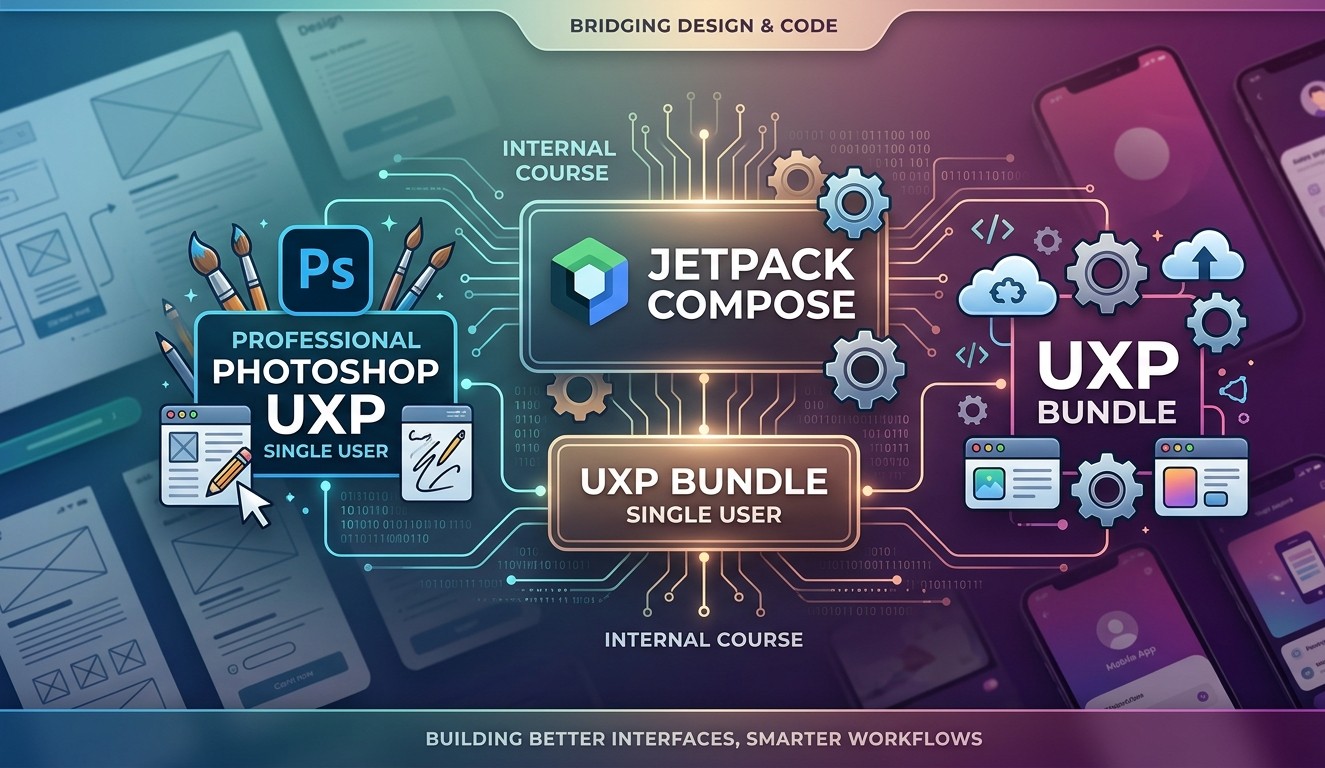

The bridge between high-quality design and seamless code is narrowing. To create world-class digital products, developers and designers must master the latest declarative UI frameworks and the sophisticated tools that power creative workflows.
I have been focusing on a specific set of resources that integrate Android development excellence with professional-grade design automation.
1. Android Evolution: Jetpack Compose & Internal Systems
Android development has shifted entirely toward a declarative mindset. By mastering Jetpack Compose, I am moving away from traditional XML to build more intuitive, reactive, and dynamic UIs.
Understanding the Internal Course structures within this ecosystem allows for a deeper grasp of state management, side effects, and how Compose handles the underlying rendering pipeline—essential for building high-performance Android applications.
2. Designing for the Future: The UXP Bundle
Modern design requires more than just static layouts; it requires extensible environments. The UXP Bundle (Single User) is at the heart of this transition. UXP (Unified Extensibility Platform) is the modern way to build plugins and automate workflows across Adobe’s creative suite.
By leveraging the bundle, I am exploring:
Workflow Automation: Reducing repetitive tasks to focus on creative logic.
Cross-App Compatibility: Creating tools that work seamlessly within the professional design ecosystem.
3. Specialized Creativity: Professional Photoshop UXP
Photoshop remains the industry standard for visual excellence. My deep dive into Professional Photoshop UXP (Single User) allows me to develop custom scripts and panels that extend Photoshop’s core capabilities. This is particularly useful for developers who need to bridge the gap between design handoffs and technical implementation.
Why This Integrated Approach Matters
Unified Vision: Knowing both Jetpack Compose and UXP allows a developer to speak the language of both designers and engineers.
Efficiency: Custom UXP tools significantly speed up the asset export and preparation process for Android apps.
Advanced UI Logic: Using declarative patterns in both mobile (Compose) and plugin development (UXP) creates a consistent mental model for building interfaces.
Conclusion
Whether it’s crafting the perfect mobile experience on Android or building powerful automation tools for Adobe Photoshop, the goal is the same: speed, scalability, and superior user experience. These resources are instrumental in pushing the boundaries of what is possible in the modern tech stack.
Are you looking to modernize your Android UI or automate your creative workflow? Let’s discuss how these advanced tools can transform your next project!